

This is the 4th and final part of my series on digestive health. I know I said last week’s post was the last, but I still have more to share!
Part 1 explained what digestion is and why it matters, and began a journey through the digestive system.
Part 2 took an in-depth look at what happens in the small intestine and the common causes of digestive complaints that start there, including celiac disease, SIBO, and food intolerances.
Part 3 looked at the large intestine: what happens there, and what to know when things don’t go quite right.
Let’s get into Part 4!

Most people know fiber is “good.”
But why?
Well, even though our body doesn’t absorb fiber, its trip through the digestive system still offers plenty of benefits. And let me tell you… the benefit goes waaay beyond bowel regularity.
Fiber Types
Before we get into the benefits of fiber, a quick review of fiber types. You read that right: fiber isn’t one thing.
Fiber is a category, just like vitamins and minerals. To complicate matters, fiber can be sorted in a few different ways, and the same fiber can fit into more than one category:
1. Solubility (what does the fiber do in water?)
Soluble Fibers
Soluble fibers dissolve in water and form a gel-like substance. This gel softens stool, slows digestion, and keeps you full longer. (Think of foods like oats and beans, which change when sitting in water.)
Insoluble Fibers
Insoluble fibers don’t dissolve in water. Instead, they add bulk and move through the digestive tract, supporting bowel regularity. (Think of foods like most vegetables and fruit skins, which don’t change when sitting in water.)
2. Fermentability (what does the microbiome do with it?)
Prebiotic Fibers
Prebiotics are fibers your body can’t digest but your gut bacteria can. When these bacteria ferment prebiotics, many of the byproducts are beneficial for health.
Prebiotic fibers are mostly soluble, but some insoluble fibers and resistant starch can also act as prebiotics. Examples include onion, garlic, leeks, and asparagus, which provide especially good fuel for those bacteria.
Resistant Starch
While not technically a fiber, resistant starch acts like a prebiotic fiber in the body. After potatoes, rice, and semolina pasta are cooked and cooled1, some of their starch is transformed into resistant starch. This is because it “resists” digestion in the small intestine and provides a food source for the microbiome. Plus, because less carbohydrate is absorbed, resistant starch has less impact on blood sugar.
3. Fiber-ish
FODMAPs
As the first word in the acronym implies, Fermentable Oligosaccharides, Disaccharides, Monosaccharides, And Polyols (FODMAPs) are short-chain carbohydrates that are poorly absorbed in the small intestine and then fermented by gut bacteria. Here are examples of each FODMAP category:
Oligosaccharides: wheat, onion, garlic, beans, and lentils
Disaccharides: lactose in milk and other dairy products
Monosaccharides: honey, apples, and mango
Polyols: sugar alcohols in stone fruits and sugar-free products
As you can see, some FODMAPs are fibers, and some are not.
I include FODMAPs here because a “low FODMAP” diet is a relatively new intervention for IBS and has brought a ton of confusion along with it.
Most people can tolerate FODMAPs. If this is true for you, continue to enjoy! The byproducts of FODMAP fermentation by the microbiome have a growing list of health benefits.
However, for those with IBS, certain FODMAPs may cause gas, bloating, and discomfort. If this is you, please, please, please know this before you try a low FODMAP diet: it is meant to be a short-term elimination diet to help you identify IBS triggers, not a long-term super-strict diet.
Plus, it is complicated to implement on your own!
Frustratingly, many people are given a handout and told to “try a low FODMAP diet” without guidance or support. The patients who eventually make their way to me have either given up trying or have been on a diet so restrictive for so long that I am concerned about nutrient deficiencies.
So please, keep my fellow dietitians and ask for support if this is something you’d like to try.
The Benefits of Fiber
Keeps stools soft and regular
Ok, yes, fiber has been typecast as the poop nutrient, and for good reason! If you’ve never had trouble pooping, consider yourself lucky, because the ability to have easy bowel movements is something too many people take for granted.
Fiber helps you stay regular in a couple of ways. First, soluble fibers absorb water, keeping stool soft and easy to pass. Second, insoluble fibers increase the bulk moving through the digestive tract, which stimulates the muscles of the digestive system and keeps everything moving.
Supports satiety
Fiber-rich foods take longer to eat and add volume to your meals, helping you stay satisfied. The gel formed by the soluble fibers also slows how quickly food leaves the stomach. You can amplify this effect by pairing fiber-rich foods with lean proteins and healthy fats.
Manages blood sugar
The gel formed by soluble fiber slows how quickly carbohydrates are digested and absorbed, which helps prevent sharp spikes in blood sugar after eating. Over time, diets higher in fiber are linked to better blood sugar control and a lower risk of type 2 diabetes.
Lowers cholesterol
Soluble fibers, such as the beta-glucan in oats and the fiber in beans and psyllium, bind to bile acids in the digestive tract and carry them out of the body in stool. Your liver then pulls cholesterol from the blood to make more bile, which lowers circulating LDL cholesterol levels.
Decreases colorectal cancer risk
Higher fiber intake, especially from whole grains, is associated with a lower risk of colorectal cancer. This may be because fiber speeds the movement of stool through the colon, bulks and dilutes its contents, and feeds the microbiome.
Feeds your gut microbiome
The bacteria in your microbiome rely on fiber as their main fuel. When they ferment it, they produce short-chain fatty acids like butyrate, which support the health of the colon lining and may play a role in immune function and inflammation. A variety of fiber-rich plant foods supports a more diverse microbiome, which is why eating many different plants matters more than relying on a single source.
Comes with an entourage
Finally, fiber-rich foods are often packaged with other important nutrients: vitamins, minerals, phytochemicals. So eating those fruits, veggies, whole grains, nuts, seeds, and lentils brings a whole lot more than fiber to the party. Cheers!
Sources of Fiber
The truth is, most foods contain a mix of different fiber types, as you can see in the chart of common fiber-rich foods below. For most people, variety is key. Eating lots of different fiber-rich foods provides lots of different fiber types, which can contribute to the impressive list of benefits outlined above.
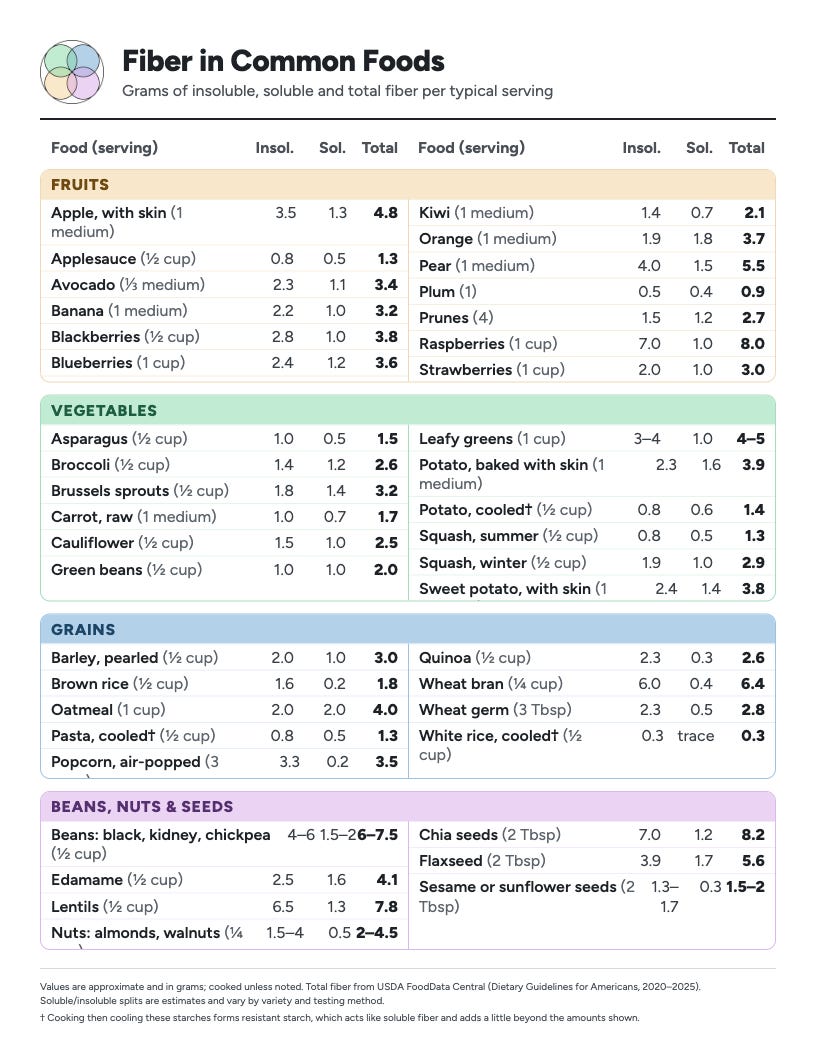
While many people can enjoy a wide range of fiber-rich foods, those with digestive problems may need to be a little more selective. If this is you, please work with your doctor, and potentially a gastroenterologist and dietitian, to determine whether changing the types or amounts of fiber you eat will help.
How Much Fiber Do You Need?
Most guidelines recommend about 25 grams of fiber per day for women and 38 grams per day for men. However, many experts agree that if tolerated, more may be better, and not only because of the fiber itself. It may also be because of the countless other nutrients in fiber-rich foods that work their magic together.
Unfortunately, most adults in the US get only about half of the minimum recommendation. If this is you, please take an extra look at the chart above. Adding an extra serving of fruit, beans, or nuts each day can go a long way toward getting the many benefits that fiber-rich foods provide.
But… easy does it. Adding too much fiber at once can cause gas and bloating, so start slow. Add a new fiber-rich food to your typical intake every few days to let your digestive system and microbiome adjust.
The Perfect Pairing
As you now know, soluble fiber works by absorbing fluid to form a gel that softens stool, increases satiety, and helps manage blood sugar and cholesterol levels.
Yet, this also means that the benefits of soluble fiber depend on having enough fluid to work.
Why is this? I like to think of soluble fiber as a kitchen sponge: dry and hard when left out on the counter but soft and pliable once it gets wet. Not enough fluid means dry, hard stools and sluggish digestion. Not fun.
How much
Several factors determine how much fluid an individual needs2, including gender, activity level, and medical conditions, among others.
Typical recommendations range from about 2.1 L per day for women to nearly 3 L per day for men. (For context, 2.1 L is about 9 cups or 71 oz, and 3 L is about 13 cups or 100 oz.)
I talk about fluid a lot with my patients, and I only recently realized that when I say “fluid,” many hear “water.” For those who aren’t big water drinkers, hearing they need over 2 L per day can be overwhelming!
The good news is that ALL FLUIDS COUNT. You heard that right. Water counts. Coffee counts. Tea counts. Milk counts. Carbonated beverages count. Heck, even juices and sugar-sweetened and artificially sweetened beverages count.
I say this to get their attention, and it usually works. Their facial expressions alone show me that they’re relieved they don’t have to force themselves to guzzle bottles of water.
Then I explain that, based on their situation, we may need to modify how much of that fluid comes from caffeine, sugar, carbonation, or whatever else. But the message doesn’t change: all fluids count! Stay tuned for a whole post dedicated to fluids and hydration!
When to be careful: Fiber isn’t one-size-fits-all.
IBS: Some fibers ferment quickly and can trigger gas and bloating. Soluble, less fermentable fibers such as psyllium are often better tolerated than wheat bran. A dietitian can help you sort out what works.
IBD (Crohn’s disease or ulcerative colitis): During a flare, or if you have a narrowed bowel, high-fiber foods may need to be limited. Follow your care team’s guidance.
SIBO: Fermentable fibers, including prebiotics and high FODMAP foods, can feed bacteria in the small intestine and worsen gas and bloating. Tolerance varies a lot, so work with a dietitian to adjust types and amounts rather than cutting fiber across the board.
Diverticulitis: During an active flare, your care team may recommend temporarily limiting fiber or following a clear liquid diet. Fiber is typically added back gradually once symptoms settle, so follow your care team’s guidance.
Diverticulosis: Good news! Having pouches in the colon wall is not a reason to avoid fiber. Higher fiber intake is linked to a lower risk of diverticular problems. The old advice to avoid nuts, seeds, and popcorn is not supported by current evidence.
Bowel surgery, strictures, or swallowing problems: Ask your doctor before increasing fiber.
Medications: Fiber can affect how some medications are absorbed, so ask your pharmacist about timing.
New bleeding, black stools, ongoing changes in bowel habits, or unexplained weight loss are worth a call to your doctor. These shouldn’t be treated with fiber alone.
The take-home
Fiber deserves its time in the spotlight. From digestive health to metabolic health to cardiovascular health, plant-based fiber-rich foods have so much to offer for many of us.
So go out there and enjoy! (slowly, of course 😉)
Thanks for being here,
~Allison
For more about fiber, check out this podcast from Gastropod.
Listen to Insight into Health:
Podcast:
In this second episode on digestive health, I walk you through the most frequent digestive complaints I hear from my patients and discuss common causes and interventions. Listen below, or anywhere you listen to podcasts (links to Apple & Spotify).
20 — Digestion 101

In this second episode on digestive health, I walk you through the most frequent digestive complaints I hear from my patients and discuss common causes and interventions.
KSVY Radio:
This week, I spoke with Certified Nutrition Consultant and Health Coach Jeanne Norsworthy about her background and the differences between a nutritionist and a registered dietitian. Listen below:

Follow guidelines to properly cool these foods to avoid foodborne illness.
You make this information easy to understand. I love asparagus and onions and garlic. I'm an occasional apple eater. Fiber-rich foods like beans are buddies. This information take some of the "shame eating" ( you don't eat enough _____________" pressure off and gives me incentives to eat more of the ones I love!