

Yeah, yeah, we know we need to eat more vegetables, move our bodies, and get more sleep.
Why is it so challenging?
Besides all of the systemic issues often making healthy choices the harder choices (food prices, cost of health and mental healthcare, and more), some of it has to do with not having a good enough reason to make the harder choices in the first place.
Knowing what to do is often not enough.
Because, let’s face it, we all have a toddler inside of us who doesn’t want to be told what to do.
Which is why, when I’m meeting a patient for the first time, I take the time to ask them what their hopes and goals are.
I don’t settle for “I want to be healthier,” either. I want to understand, specifically, what being healthier looks like to them. This provides valuable information for both of us as we work to understand what is between them and their healthier self.
Finding Your Why
Health is so much more than a number. I rarely meet a patient who is motivated to exercise in order to lower their blood pressure or to eat less ice cream to see their A1c (marker of long term blood sugar levels) go down.
Sure, I’ve had individuals who are motivated by the numbers, but this is usually because they’ve experienced a family member become debilitated by uncontrolled diabetes or a they have had a friend suffer an unexpected heart attack. Yet, if you really think about it, even these examples are so much more than a number.
Insight into Health Framework
If starting to think about what being healthy means to you feels overwhelming, the Insight into Health framework was made for you.
Before jumping to the middle of the circle, which is the what to do, I urge a little patience.
Starting on the outside of the circle, ie figuring out why you want to be healthy in the first place, can go a long way to informing where to start.
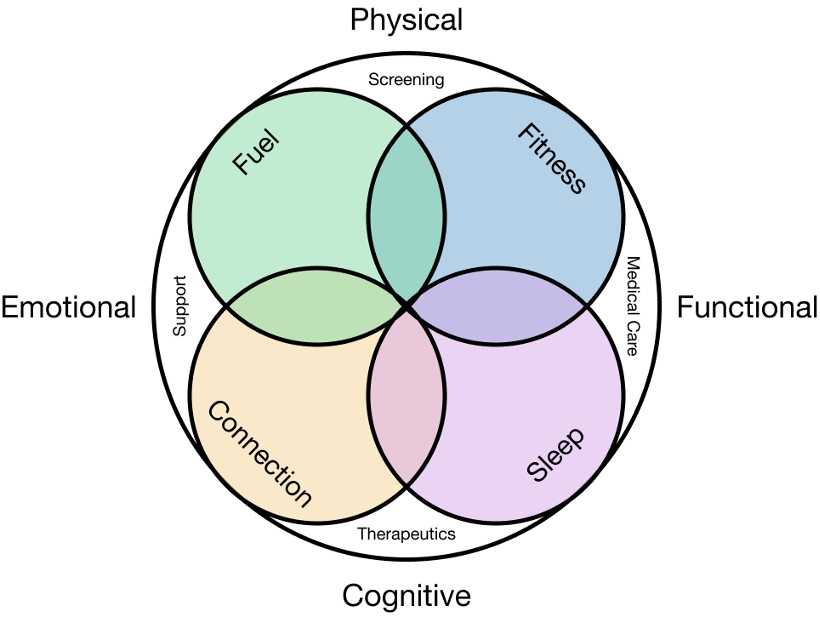
I think about health falling into four main categories:
Physical Health: How you feel and how well you take care of your body to prevent and/or manage chronic diseases.
Functional Health: Your body’s ability to do what you want it to do.
Cognitive Health: Ease of thinking, focusing, and remembering (check out my cognitive health guide here).
Emotional Health: Being able to experience, express, and manage a range of emotions.
Each of these areas of health interacts, which means that improving one often improves the other. For example, I’ve worked with plenty of people who have worked to improve their functional health, which has led to improvements in their emotional health.
As you consider your own life and goals, ask yourself the following questions:
What areas of your health do you feel good about?
What might you want to change about your health?
In which areas of health are you hoping to see gains?
What aspects of health do you not want to lose?
There are no right answers here.
One person may think about what they need to stay functionally independent, while someone else may think about the things that bring them joy and good quality of life. Keep reading for more detailed examples.
Present & Future Health
If you were like my younger self, middle age and beyond seemed light-years away. It wasn’t until I’d lived those years that I experienced how quickly those years go by.
I can finally see into what is, hopefully, decades ahead of me, and I’ve come to appreciate that while getting older will come with changes to my body, ignoring those changes is not an option.
I’m choosing to follow the old addage, “if you don’t use it, you lose it,” which involves thinking about my health now and into the future.
By future, I’m talking about everything from next year to the next decade (or several).
If I want to swim later, I also need to swim now. Just keep swimming, as it goes.
One Step at a Time
Once you’ve come up with your working definition of health, it is time to take the first step (into the middle of the framework), which involves small things that you can do every day:
Fuel: Feeding and hydrating yourself
Fitness: Moving your body
Sleep: Prioritizing and valuing sleep
Connection: Finding belonging and an uplifting community
You may find that, just as different areas of health interact with one another, so too do the actions that support them. Better sleep may lead to better connections or more energy to move your body, for example.
Fuel
You can find more about fueling yourself here. Be on the lookout for a hydration health guide, coming soon!
Fitness
Until my fitness guide is ready, below are some basics to get you started.
Different types of fitness activities contribute to physical function. Incorporating each type of exercise throughout your day and week is important for all categories of health:
Cardiovascular (“cardio”) activities include swimming, walking, jogging, biking, hiking, dancing, and more! They increase heart and breathing rates, supporting heart, lung, and brain health.
Resistance training includes exercises such as body-weight exercises, resistance bands, hand weights, machine weights, Pilates, certain types of yoga, and more! The goal is to progressively challenge different muscles and muscle groups to enhance muscle mass, strength, and bone density.
Balance practices such as yoga, tai chi, single-leg standing, walking backwards, and more! They require coordinating your body in space, reducing your risk of falling.
Flexibility exercises, including yoga, Pilates, dynamic stretches, static stretches, and more! They promote muscle relaxation and lengthening, decreasing injury risk and pain.
Remember, it doesn’t have to feel like exercise. Make it fun and try new things. And even better? Make it a time of connection.
Connection:
Connection involves cultivating positive relationships with yourself and others:
Self:
All too often, the thoughts that go through our heads are full of rumination about the past and worry about the future. While being hypervigilant used to be an important survival mechanism, you can pull your thoughts to the present by:
Narrowing in on what you can hear (Car engine? Bird? Washing machine?)
Feeling the sensations in your body (your feet on the ground, your seat in a chair, the silkiness of the water)
Naming what you see (tree, coffee cup, book).
Others:
We need each other for our safety and survival. Connection and belonging are both key components of emotional health. Support your emotional health by:
Setting regular calls, walks, or coffee dates
Signing up for a class, book club, exercise class, or local organization
Volunteering
Saying “yes!” to new experiences
What Else?
Some astute readers may be wondering: what about the other words on the Insight into Health framework graphic?
Screening? Medical care? Therapeutics (medications & supplements)? Support?
These, too, are important in optimizing health. But, it’s when these factors are combined with fuel, fitness, sleep, & connection that things start to get exciting.
Thanks for being here,
~Allison
Please remember that this information is meant to educate and inspire, but is not medical advice - please consult your healthcare team to determine what is most appropriate for you.
You are so encouraging and practical! You write for regular women like me, 63 and wanting to be better and do better in a realistic way! Thank you!