

Part 1 of this series explained what digestion is and why it matters, and began a journey through the digestive system.
Part 2 took an in-depth look at what happens in the small intestine and the common causes of digestive complaints that start there, including celiac disease, SIBO, and food intolerances.
Today, we wrap up the series with the large intestine: what happens there, and what to know when things don’t go quite right.
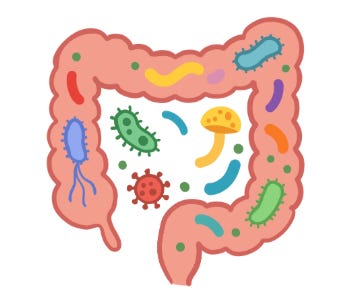
Large Intestine/Colon
“Large intestine” and “colon” are often used interchangeably. Technically, the large intestine has three parts: the cecum (a pouch where the small intestine empties into the large intestine), the colon, and the rectum (where stool is stored until it passes out through the anus).
The colon is the longest portion of the large intestine and is made up of four continuous sections. The ascending colon travels up the right side of your abdomen. The transverse colon crosses from right to left. The descending colon travels down the left side, and the sigmoid colon, which is an S-shaped curve that leads to the rectum.
As contents move through the colon, water and electrolytes are absorbed and stool is condensed. The colon is also home to most of your gut microbiome: the community of bacteria, fungi, and other microbes that plays a key role in our health.
Poop, Stool, Bowel Movement, Feces, #2, Passing Gas, Tooting, Breaking Wind…
Talking about what comes out of our bodies makes most people squirm, which is why, in my opinion, we’ve invented so many names to get around the discomfort.
Yet what comes out of your body is an important sign of what’s going on inside it. So please get comfortable looking at your poop, talking with your healthcare team about anything that concerns you, and remember... Everyone Poops!
Microbiome
The microbiome has many roles, including fermenting undigested fibers to produce short-chain fatty acids, supporting immune function, producing vitamins (e.g., vitamin K and several B vitamins, such as biotin and folate), and more.
The microbiome is also an integral part of the “gut-brain axis,” a two-way communication network between the digestive tract and the brain.
We still have a lot to learn about the microbiome and all the ways it affects health. We don’t know exactly what makes up a healthy microbiome, or if there even is an ideal one. What we do know is that a diverse, balanced community seems to matter more than any single “good” bacterium or other microbe.
Prebiotics, Probiotics, & Postbiotics — oh my!
Talking about the microbiome assuredly brings up thoughts of, and questions about, the “biotics.” First, some terms:
“-biotic” refers to living things.
“Pre-” means before, so prebiotics are the fibers and other compounds that feed the living gut microbes.
“Pro-” means in support of, so probiotics are live bacteria and other microbes that may support health.
“Post-” means after, so postbiotics are what’s left behind after microbes ferment fibers and other substances. These include short-chain fatty acids like butyrate, vitamins, and more.
Probiotics: Food or Supplement?
If you are reading “probiotic” and think of a supplement, I don’t blame you. The claims on those bottles are enticing! (For more on navigating supplements, check out my Supplements 101 Health Guide.)
The truth is, we don’t know enough about most probiotics (types, amounts, combinations, or duration) to confidently recommend them for most conditions. There are exceptions, of course, such as using probiotic supplements to reduce the risk of antibiotic-associated diarrhea (there’s another “biotic” for ya).
For now, my recommendations regarding probiotic supplements are:
Food first. Include food sources of probiotics as often as possible (ideally daily), such as yogurt with live and active cultures, kefir, sauerkraut, kimchi, and kombucha. For sauerkraut and kimchi, choose refrigerated, unpasteurized versions, since heat processing kills the live microbes.
If you’re healthy, you probably don’t need a probiotic supplement.
If you’re interested in a probiotic for a health condition or digestive complaint, talk with your doctor. Feel free to share this resource with them on evidence-based probiotic use for various conditions.1
If you do use a probiotic supplement, remember it’s usually meant for a specific purpose and time frame, not forever. Part of my Supplements 101 Health Guide walks you through how to tell if a supplement is working and when you no longer need it.
Common Large Intestine Complaints
In the patients that I see, digestive symptoms are among the main causes of poor quality of life. I suspect that this is due to the physical discomfort, but also social taboos and the fact that it may affect what a person can comfortably eat when out and about.
Gas: A natural process and created as a byproduct of bacterial fermentation and/or swallowed air (eating quickly, chewing gum, carbonated drinks, sleep apnea machines).
Most healthy adults pass gas 10 to 20 times a day. Most gas has no odor, though eating eggs, meat, dairy, beans, and some veggies may increase the amount of fragrant sulfur in these gases.
Don’t let a fear of gas prevent you from eating fiber! If you are working on increasing fiber in your diet, go slowly. Add one new fiber-rich food every few days to give your microbiome a chance to adjust.
Bloating is a sensation of fullness or tightness in the abdomen caused by trapped gas, slow digestion, or merely being more sensitive to normal amounts of digestive gases. Bloating may be worsened by swallowing large amounts of air, eating large meals, constipation, certain foods, and food intolerances.
Distention is more of a medical term that refers to a visible and measurable increase in the size of the abdomen. Bloating can occur with and without abdominal distention.
Constipation has several medical definitions, based on bowel movement frequency, stool consistency, ease of passing stool, and the sense of completeness. Because every digestive system has its own rhythm, the best clue is often a change from an individual’s typical bathroom habits.
Frequency: “Normal” ranges widely, from several times a day to every other day. A change in pattern (e.g., twice a day to every other day) with other symptoms is often more important than frequency alone. That said, fewer than three bowel movements a week is a sign that you may be constipated.
Consistency: Clinicians use the Bristol Stool Chart (caution, there are visuals!). Type 4, "smooth, soft, and snake-like," is the goal (some providers say "like soft serve"). Types 1 and 2, hard and lumpy, point to constipation. Look at your poop! It tells you and your care team a lot.
Ease: When you feel the urge to have a bowel movement, go! A healthy bowel movement shouldn’t require straining or cause pain and typically takes no more than 5 minutes. Straining and long toilet sits raise your risk of hemorrhoids.
Pro tip: Due to the shape of your colon and rectum, it can help to put your feet up on a stool to raise your knees to, or above, the level of your hips (if comfortable). This straightens out the trip the stool has to make (which explains why hunter-gatherers squatted to poop).
Completeness: Simply having regular bowel movements doesn’t clear you from being constipated. Daily, small, incomplete movements can slowly cause a stool to back up. How can you tell if you’ve had a complete bowel movement? Well, first look at the amount and compare it to what is typical. Then check in with how you feel — if you feel like there is more in there, there likely is. Finally, a complete bowel movement usually comes with pretty easy cleanup, if you know what I mean. If you are wiping for days, that may be a sign that there is more in there.
Diarrhea is, in some ways, the opposite of constipation: more frequent, urgent, very loose or watery stools (Bristol Type 6 or 7). Common causes include viral or bacterial infections, parasites, food intolerances, medications (including antibiotics), and chronic conditions like IBS, celiac disease, and inflammatory bowel disease.
Diarrhea can increase the risk of dehydration, so consuming enough fluids is a high priority. Sip water, broth, or an oral rehydration solution (such as Pedialyte), which replaces both fluid and electrolytes. Sports drinks and juice are okay in a pinch, but they’re high in sugar and lower in sodium, and sugary drinks may worsen diarrhea in some people.
Parasites (ex: Giardia, Cryptosporidium): Spread through contaminated water, food, or person-to-person contact. They can cause diarrhea, gas, bloating, cramping, nausea, and weight loss if the infection goes on for a while.
Diverticulosis/Diverticulitis: Diverticulosis means small pouches (diverticula) have formed in the wall of the colon. It’s common, increases with age, and usually causes no symptoms. If those pouches become inflamed or infected, it’s called diverticulitis (“-itis” means inflammation), which often includes abdominal pain (typically lower left), fever, nausea, and changes in bowel habits.
It was once thought that small food particles like seeds, nuts, and popcorn could get trapped in diverticula and cause inflammation and infection. However, newer research shows that eating these foods does not increase the risk of developing diverticulitis, and eating more high-fiber foods is a helpful way to prevent constipation, which may lead to a diverticulitis “flare.” Note, if you do experience a diverticulitis flare, check with your medical team about appropriate nutrition recommendations.
IBS vs. IBD:
The names sound alike, and both can cause abdominal pain and changes in bowel habits, but they are different conditions. IBS is a disorder of how the gut functions. IBD involves visible inflammation and tissue damage.
IBS (Irritable Bowel Syndrome): A disorder of “gut-brain interaction”, meaning the two-way messages between the gut and the brain affect how quickly (or slowly) contents move through the digestive tract and often being more sensitive to the feelings of normal digestion. IBS may cause bloating, gas, bowel urgency, and symptoms that flare with stress, certain foods, or disrupted sleep. In short, the gut looks normal on testing, but it doesn’t work normally.
Subtypes: IBS-C (constipation-predominant), IBS-D (diarrhea-predominant), IBS-M (mixed, alternating between the two), and IBS-U (unclassified). Symptoms can shift between subtypes over time.
IBD (Inflammatory Bowel Disease): Chronic inflammation of the digestive tract that damages the gut lining. The exact cause isn’t known, but genetics, the immune system, the microbiome, and environmental factors all play a role. In short, the digestive tract does not look normal, and inflammation is present.
Crohn’s disease: Can affect any part of the GI tract, though it most often involves the end of the small intestine and the colon.
Ulcerative colitis (UC): Affects only the colon and rectum.
Having IBS does not lead to IBD, though the two can coexist. IBS is typically treated with dietary changes, stress management, and symptom-targeted medications. IBD is treated with medications and sometimes surgery.
Hemorrhoids:
Hemorrhoids are swollen veins in the rectum and anus and can occur both internally and externally. They are very common and rarely dangerous, but can cause bleeding, pain, and itching. More on digestive health “red flags” soon, but please consult your doctor if you have rectal bleeding so that the cause can be investigated.
Hemorrhoids are often caused by chronic constipation, straining during bowel movements, sitting on the toilet for long periods, low fiber intake, pregnancy, and heavy lifting. Risk rises with age.
Much more on food and lifestyle interventions to prevent constipation and promote healthy bowel movements next week, but for now, know that eating enough fiber, drinking enough fluids, regular exercise, and limiting time sitting on the toilet can all prevent hemorrhoids.
Listen to Insight into Health:
Podcast:
It is Digestive Health Month on the Insight into Health podcast! Listen to my conversation with Dr. Marci L. Hardy, PhD, MA, as we discuss how to feel more comfortable talking about your bodily functions (links to Apple & Spotify).
Everyone Poops!

Once again, I was joined by Dr. Marci L. Hardy, PhD, MA, to discuss how to become more comfortable talking about your bodily functions.
KSVY Radio:
If you missed Insight into Health live on KSVY 91.3 radio on Monday at 7 pm PT, check out my conversation with the TJ Carter Band on music, creativity, and moments of magic.
Thanks for being here,
~Allison
This information is meant to educate and inspire but is not medical advice. Please consult your healthcare team to determine what is most appropriate for you.
Enjoy all your topics!!!
Your “completeness” point deserves a spotlight: going every day doesn’t rule out constipation. Small, incomplete movements can back things up for weeks before anyone calls it a problem. Great series.