


By the time I became a Registed Dietitian (Nutritionist) in 2010, I had completed 7 years of schooling, including an undergraduate degree in biology and a graduate degree in nutrition science.
Ok, you might be thinking, you spent 7 years learning about “healthy eating?”
No…and yes. Nutrition is one of those terms that is thrown around without really grasping what it is referring to. Consider this:
Nutrition is the science of how the nutrients we consume are digested, absorbed, and used to support metabolism.
There’s a lot there. Way more than just eating your broccoli, that’s for sure.
Let’s break it down.
Science
Nutrition is a science. Principles that I share are based on well-designed scientific studies. But science changes. When we learn better, we pivot, often leaving a generation of frustrated people in our wake. I get it. But I’d much rather admit when I got it wrong than dig my heels in the sand.
Nutrition is not a diet, a fad, a headline, or a supplement. Nor is it about perfection, restriction, or guilt. There is no one-size-fits-all here.
Nutrients
Nutrients include energy (Calories), macronutrients (protein, carbohydrate, fat), and micronutrients (vitamins, minerals, & phytonutrients). Much more on each of these in a moment.
Digestion
Digestion is the process of breaking down food using mechanical and chemical processes so that it can be absorbed. This occurs in the mouth, continues in the stomach, and really gets to business in the small intestine.
You may think about eating, even healthy eating, as what you put into your mouth. Yet, that’s just the first step. If you are to get the benefit of the nutrients you eat, digestion is is a key second step. It’sthe prep crew, if you will.
If digestion doesn’t happen well? That healthy food comes out the opposite direction than it came it…if you know what I mean. Not to mention the gas, bloating, and other symptoms that often accompany poor digestion.
Absorption
If eating is step one, and digestion is step two, the third step of absorption is the gateway to the rest of your body.
Absorption is the process of nutrients passing from your digestive tract into your bloodstream on a journey to the rest of your body.
Every cell, tissue, and organ system requires energy from food and nutrients that provide building blocks for growth, maintenance, and repair.
More on both digestion and absorption in my digestive health guide, coming soon!
Metabolism
Metabolism is about so much more than dictating your body weight. It is all of the processes and reactions within your body (the “orchestra”) that keep you alive.
Metabolism powers your heart, lungs, brain, muscles, & more. (Fun fact: The brain makes up ~2% of body weight but uses about 20% of energy at rest).
Metabolism builds, maintains, & breaks down muscle, bone, body fat, hormones, enzymes, & immune cells.
Metabolism helps manage blood sugar, facilitate nerve signaling, fluid & electrolyte balance, inflammation, body temperature, and cell, tissue, & organ repair.
In short, metabolism keeps you alive.
Murch more on metabolism in episodes #10-13 of the Insight into Health Podcast.
Nutrition Fads

I can’t talk about nutrition without addressing diet fads. Unfortunately, nutrition is all too often tied up with body weight and the desire to change it and control it. This, in turn, conjures up a sense of restriction, guilt, and shame.
See what I’m up against?!
Each macro has had its time in the spotlight. The 1980’s and 90’s were the low-fat days, the 2000’s brought around the stubborn low-carb craze, and we are currently in the midst of high-protein everything.
The tricky thing about these fads is that each is based on what I call “a nugget of truth.” A nugget that, unfortunately, gets blown out of proportion, overgeneralized, and loses its nuance.
So what are the nuggets of truth for each of these macro fads?
Low-Fat:
Eating too much of some kinds of fat may increase your risk of heart disease, obesity, and other chronic diseases.
This doesn’t apply to all fats. Sure, not overdoing it on the butter, bacon, cheese, etc. is generally a good approach. Unfortunately, the low-fat trend also pulled down unsaturated fats like those found in fatty fish, nuts, seeds, avocados, and olive oil, etc., which may decrease risk of heart disease, some cancers, Alzheimer’s disease, and more.
Low-Carb:
Frequently consuming food and drinks high in added sugars & highly processed flours (which replaced much of the fat in the low-fat days) is linked to increased weight, blood sugar, and other metabolic-associated diseases.
This doesn’t apply to all carbs (sound familiar?). High-quality, minimally processed carbs such as fruits, beans, and sweet potatoes have no business being associated with sodas, chips, or cookies.
High-Protein:
I’ve been convinced that the RDA (Recommended Daily Allowance) for protein greatly underestimates how much protein most of us need, especially in midlife and beyond. Adequate protein can help maintain muscle mass (which decreases with age), promote satiety (feeling satisfied between meals), and manage blood sugar.
But, this doesn’t mean that eating high-protein chips, ice cream, and popcorn (yes, these are all real products) is the answer to our health goals.
Meal Planning Principles & Macronutrients

I don’t make meal plans for people, despite being asked for them all the time.
I’ve learned that even if I create what I think is the most amazing, delicious, and healthy meal plan, it is too subjective of a task for me to get it right for someone else (“oh, I don’t like avocado,” “I don’t know how to cook that,” “ugh, I can’t stand cottage cheese!”).
Instead, I’ve found that by teaching the principles I use to make a meal plan, not the meal plan itself, people are empowered and can make healthy eating their own.
Some overarching principles to keep in mind:
Meal planning needs to be realistic, sustainable, and enjoyable. If you love to spend 3 hours on a Sunday cooking meals for the week, great, go for it. If Sunday rolls around and meal prep is hovering over you like a black cloud of obligation, that’s probably not the right approach for you.
Use mostly “whole” foods and keep it simple. You don’t need to have gone to culinary school (I didn’t) or spend hours in the kitchen to eat healthy-ish, delicious meals. Simple is the key to making healthy eating realistic & sustainable. We’ve got lives to live, after all.
Put your food to work! By understanding how different macronutrients (protein, carbs, & fat) work in your body, you can manipulate how those macronutrients work to better meet your goals:
Protein: Makes a meal more satisfying, promotes balanced blood sugar, and provides the building blocks for muscle growth & maintenance.
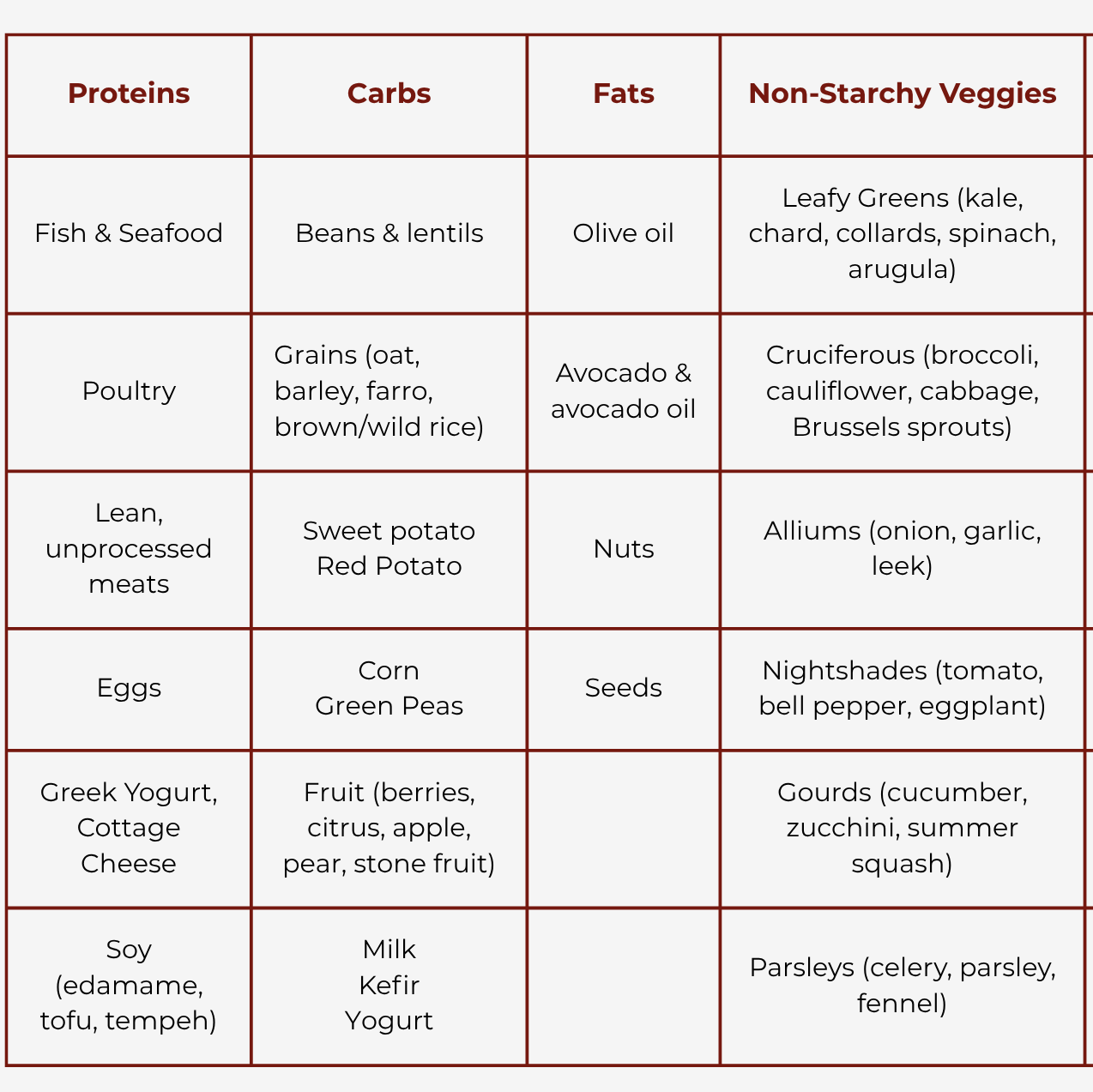
Carbohydrates: Provide the energy you need to power your brain, heart, lungs, muscles, and more. “Single-ingredient” carbohydrates (see chart below) provide a slow, steady drip of energy between meals to help keep you alert and focused.
Fats: Improve absorption of Vitamins A, D, E, and K, provide essential brain structure, and act as a secondary energy source.
Fiber: While not really a macronutrient, the fiber found in veggies, beans, lentils, fruit, avocado, and nuts & seeds supports bowel function, blood sugar and cholesterol levels, and more.
Make it Your Own
If it sounds simple, it is. I’ve just walked you through the framework that I use with most of my patients. Understand what different macros do in your body, and then, depending on your needs and preferences, experiment with how changing the types, amounts, and pairings of different macros.
Use this simple chart to get you started. For most people, including a protein and a carb with each meal and snack is a good place to start, and if you can get a healthy fat and/or a starchy veggie in there too, awesome.
Micronutrients

If macronutrients (protein, carbs, and fat) provide the raw materials for the body to function, repair, and build, then micronutrients are the cofactors, aka “workers”, that get stuff done.
The energy from carbohydrates, for example, doesn’t just jump to work as soon as you swallow. After a complicated process of digestion and absorption, an even more complicated metabolic process turns it into energy for the cells:
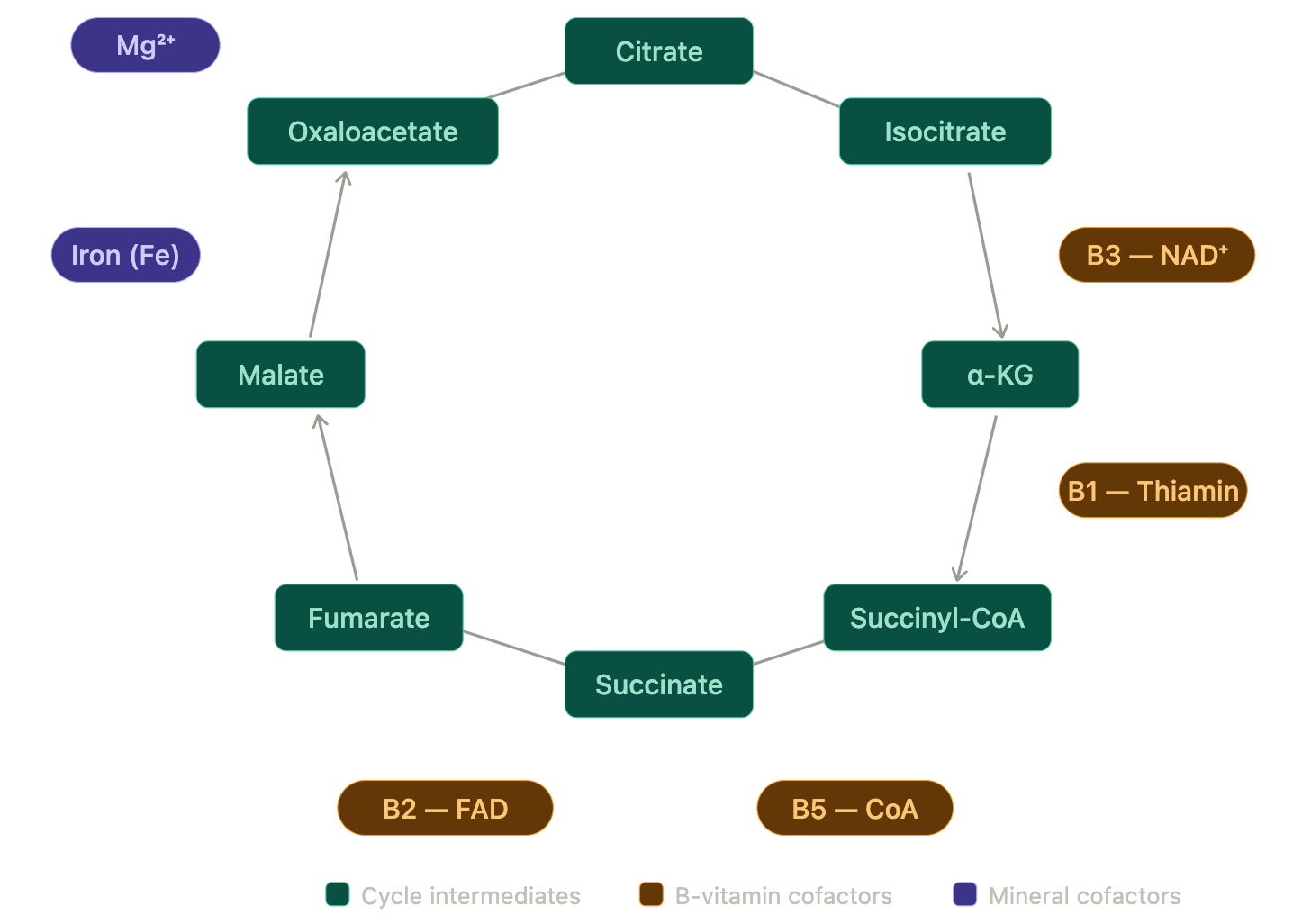
Don’t worry, I won’t test you later. This dizzying diagram demonstrates that Vitamins B1, B2, B3, & B5 (in brown), as well as minerals iron & magnesium (in purple), are essential for carbohydrate metabolism.
Now, consider that this is only one part of carbohydrate metabolism!
Without enough vitamin and mineral cofactors, your health, energy, and function are impaired.
Inadequate Vitamin B1, for example, can cause a condition called beriberi (very rare in the US), which may cause fatigue, weakness, numbness, heart failure, fluid retention, memory impairment, confusion, irritability, and more.
This condition can be avoided by regularly consuming whole or enriched grains, nuts & seeds, and soy, and avoiding chronic alcohol abuse, which is the main risk factor for this deficiency in the US.
Below are two charts I put together to show why I included each group of foods on the macronutrient chart, above - they also provide a range of important micronutrients.
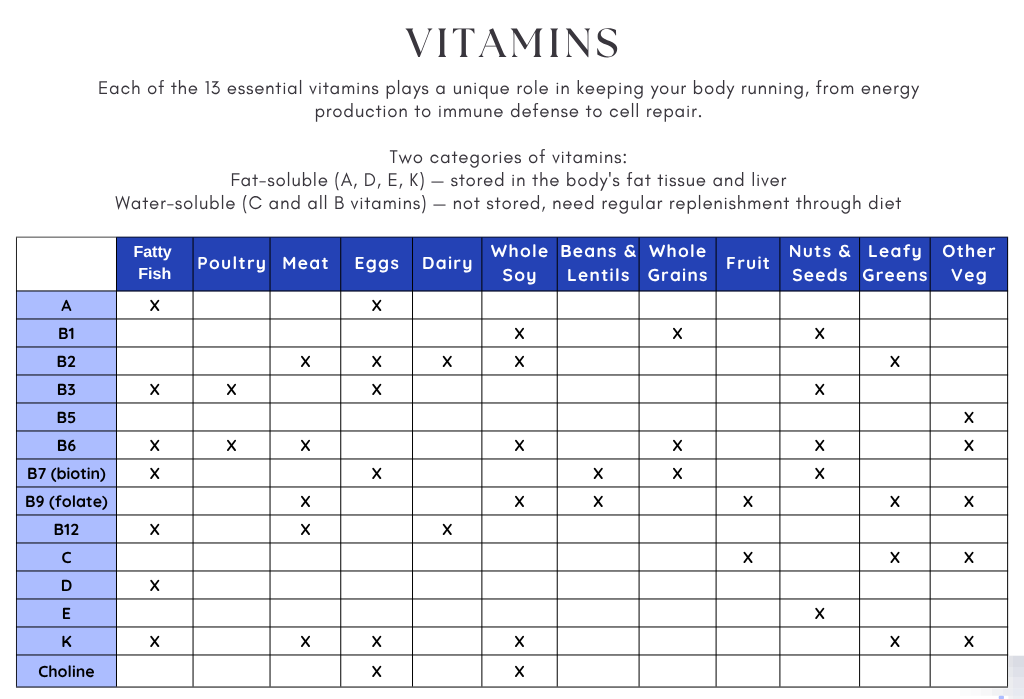
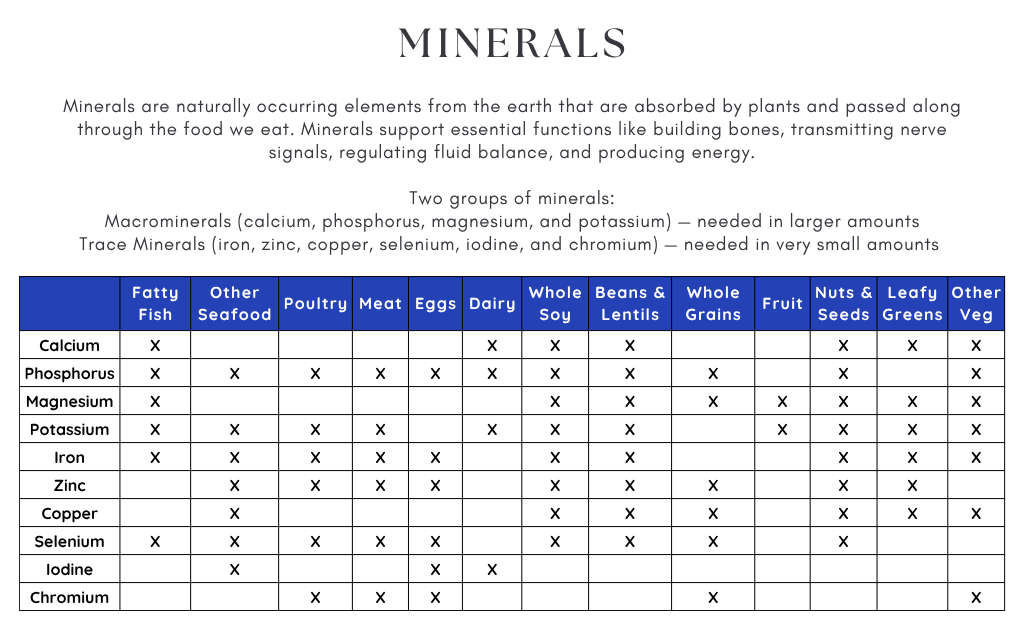
You won’t be tested on these charts, either. Full disclosure, I would probably fail the test, too.
After looking at this, though, I hope you can see that nuts & seeds, for example, are more than just trail mix. They are a secret source of more than half of the vitamins and minerals that your body needs to work at its best.
Well, there you have it, your nutrition primer.
What was your top takeaway?
Thanks for being here,
~Allison
Please remember that this information is meant to educate and inspire but is not medical advice - please consult your healthcare team to determine what is most appropriate for you.