

I remember when my grandma’s memory started to falter. I was in grad school.
She would tell me the same stories and ask me the same questions.
She knew something was off. Yet, like her doctor at the time, I brushed it off:
“Grandma,” I said, “you need to focus so you don’t forget.”
Now, I feel awful about saying that. Placing blame on her probably did more harm than good.
It wasn’t a matter of focus at all. It was the first sign of Alzheimer’s disease.

Fast forward 8 years, and, because of one of those situations of being in the right place at the right time, I had the opportunity to work with a program for the Buck Institute for Research on Aging, which is just over the hill from where I live.
At the time, research was emerging that suggested that much of one’s risk for Alzheimer’s Disease is modifiable.
So I dove into the literature, and sure enough, there was hope after all.
I had the honor of developing a nutrition education curriculum and working one-on-one with patients and providers to use lifestyle (including nutrition) approaches to support their cognitive function.
The research and the hope have continued to grow. Alzheimer’s disease isn’t inevitable. Modifiable risk factors (meaning, things you can do something about) make up an estimated 45% of the risk for developing Alzheimer’s disease.
That isn’t a small number.
What is Cognitive Health?
Cognitive health is the ability to think clearly, learn, remember, and make decisions that support independent daily life and overall well-being. It encompasses several interconnected domains of brain function, including:
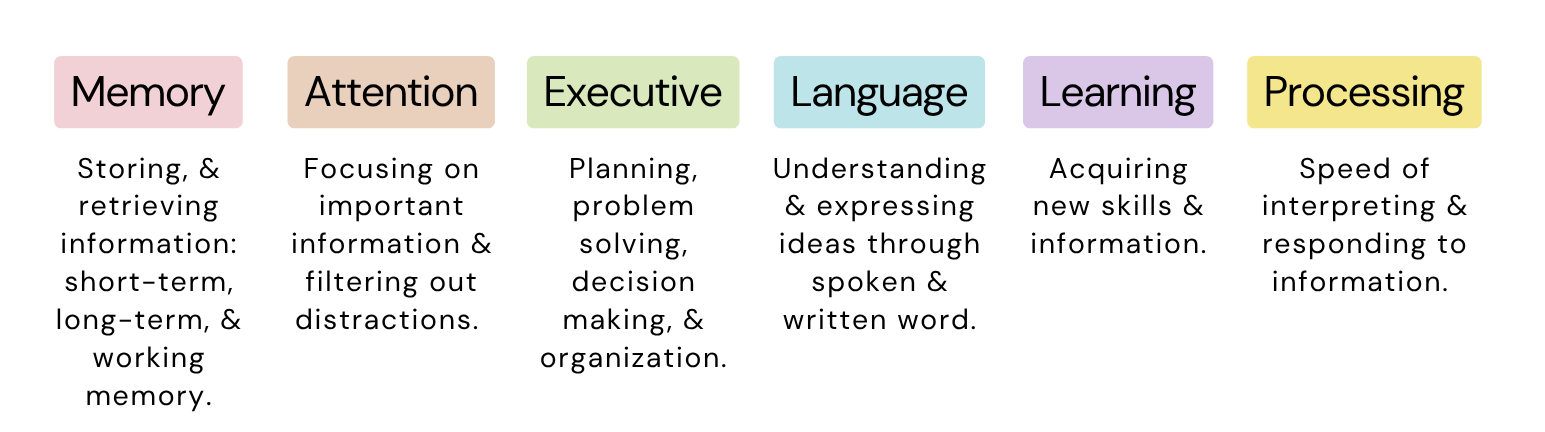
Yes, cognitive health includes memory, but it is waaaaaay more than memory.
It is identity. It is independence.
Is Cognitive Decline Inevitable?
For the most part, no.
A little slowing of processing speed — recalling a name, following fast conversations, for example — may be part of the brain aging process. But this certainly doesn’t steal identity or independence.
Anything more than mild processing speed changes is cause for investigation because it suggests there may be something in the brain disrupting how it functions.
In the case of Alzheimer’s disease, accumulation of amyloid-beta and tau-tangle proteins are thought to cause progressive cognitive decline.
Alzheimer’s Disease
Sometimes people use “dementia” and “Alzheimer’s disease” interchangably, but they are different.
Dementia is an umbrella term to refer to a number of neurodegenerative conditions that lead to cognitive decline. Alzheimer’s disease happens to be the most common form of dementia.
Alzheimer’s disease accounts for an estimated 60–80% of diagnosed dementias, making it by far the most studied and the primary focus of research on cognitive decline prevention.1
What have we learned?
Amazingly, typical Alzheimer’s disease isn’t something left to fate. Individual risk for this disease involves a combination of non-modifiable (things you can’t change) and modifiable (things you can change) risk factors.

Non-Modifiable Risk Factors:
Age — Risk of chronic diseases, including Alzheimer’s disease, goes up with age.
Biological sex2 — Women represent approximately two-thirds of all Alzheimer’s cases, which we are still trying to understand.
This difference is not fully explained by longer lifespan, and research is actively exploring the roles of estrogen/menopause, depression, reproductive history, and historically lower access to education and cognitively stimulating work.
Genetics — The vast majority of Alzheimer’s genetic research has focused on the APOE gene3, which accounts for an estimated 20–25% of population-level risk. Importantly, APOE risk is not deterministic, meaning even the highest-risk combination does not guarantee developing the disease.
The APOE gene comes in three forms:
APOE-2 — associated with decreased risk of Alzheimer’s disease
APOE-3 — associated with neutral risk (neither increased nor decreased)
APOE-4 — associated with increased risk of Alzheimer’s disease
Since we each inherit two copies of the gene (one from each biological parent), the six possible combinations are:
APOE 2/2, 2/3, 3/3, 2/4, 3/4, 4/4
APOE 3/3 is the most common combination
APOE 3/4 increases risk approximately 2–3x compared to APOE 3/3
APOE 4/4 increases risk approximately 8–12x compared to APOE 3/3
What Does that Mean?
Ok, I know that went deep into the science for a moment. So let’s take a step back and put everything into perspective.
Understanding each risk factor is important information as you figure out where you are and what you need to do to influence what happens going forward.
When it comes to genetic risk, I know it can be scary, and some people would rather not know. That’s ok.
For me, I choose to look at genetic risk as a motivator. I want to know all the cards on the table so I can make my next move.
Even if my genetic risk is high, remember it is not guaranteed that the disease will develop.
This is an important distinction.
Modifiable Risk Factors:
Not long ago, an Alzheimer’s diagnosis came with little more than advice to “get your affairs in order.”
Those worried about their own risk had little guidance and even fewer concrete steps they could take to prevent the onset or progression of the disease.
I don’t blame science or medicine for this.
The brain is so complex. If back then we were in the infancy of understanding its complexities, then today we are mere adolescents.
Yet, the good news is that 2024 Lancet Commission report estimated that 45% of all dementia diagnoses are due to modifiable causes, meaning things that you can monitor and address with your healthcare team.
This is huge! Oh, and by the way, these factors aren’t just good for your brain, they are good for your whole body:
Level of education — While most research refers specifically to formal higher education, being a lifelong learner in any sense of the word can only help support your cognitive health. Take a class, join a book club, learn a language, pick up an instrument. Curiosity counts.
Traumatic brain injury (TBI) — Falls, car accidents, and sports are the leading causes of concussion and brain injury. While we can’t go back and change any history of brain injury, we can stay off of ladders, put handrails and anti-slip mats in the shower, and always wear seatbelts.
Elevated LDL-cholesterol — The adage “What is good for your heart is good for your brain” continues to hold true. It includes monitoring for and managing plaque-forming cholesterol. Talk with your doctor about whether the more aggressive LDL targets published recently apply to you.
High blood pressure (hypertension) — Working with your doctor to keep your blood pressure in a healthy range won’t just make them happy; it will protect your heart and brain.
Smoking — While smoking increases the risk of dementia, long-term cessation significantly lowers it. In fact, quitting in middle age or later and staying smoke-free may reduce dementia risk to that of a non-smoker after 8–10 years. It is never too late to quit.
Diabetes — Chronically high blood sugar damages the brain and may increase Alzheimer’s Disease-related pathology over time. Monitoring for and managing high blood sugar, prediabetes, and diabetes goes a long way in protecting your brain.
Excessive alcohol intake — “Excessive” is currently defined as more than 21 units of alcohol per week, compared to fewer than 14 units, with a 4–5oz glass of wine, 12oz beer, and 1–1.5oz of liquor each counting as one unit. That said, some research suggests there is “no safe level of alcohol consumption for dementia,” especially for women and those carrying the high-risk APOE-4 gene.
Obesity — The number on the scale is my least favorite health metric, for it is often more harmful (to mental health) than helpful. That said, excess body weight, particularly around the midsection, is associated with increased risk for several chronic diseases, including dementia. If this applies to you, focusing on the lifestyle and medical strategies covered here is a more meaningful and comprehensive place to start.
Physical inactivity — Any movement is better than no movement (and it isn’t too late to start!) was a primary takeaway from the Women’s Health Symposium I attended yesterday. In fact, physical activity may be the most important factor in protecting your cognitive health, with regular movement being the key.
Depression — Appropriately treating depression and other mental health challenges, especially in midlife, is an important step in protecting long-term brain health. Seek support, whether through therapy, medication, lifestyle changes, or a combination. Your brain health is worth it.
Social isolation — Humans are wired for connection, and the brain thrives on meaningful social engagement. Chronic loneliness and isolation have been shown to accelerate cognitive decline. Prioritize your relationships, stay involved in your community, and don’t underestimate the powerful protective effect of simply spending time with people you care about.
Hearing loss — Sensory input is essential for keeping the brain active and for maintaining and forming new brain cell connections. Untreated hearing loss not only reduces a critical sensory channel, but it is also often socially isolating, compounding the risk even further. Wear those hearing aids if you need them!
Vision loss — Untreated vision impairment can be socially isolating and may reduce engagement in cognitively stimulating activities such as reading, writing, and art. Stay current with regular eye exams, and let this be extra motivation to manage your blood sugar and blood pressure, both of which can also affect your vision.
Air Pollution — This risk factor is often considered a “social determinant of health,” meaning that people of lower socioeconomic status are more likely to work and live in communities with higher levels of air pollution. Relocating away from polluted areas is not a realistic option for most, but it is worth acknowledging that chronic exposure to this environmental factor does play a role in long-term brain health.
I suspect that this list of modifiable risk factors will continue to grow, providing us all more hope and agency for protecting our cognitive health.
Fueling Your MIND

Until about a decade ago, we had a hunch that the Mediterranean diet was good for the brain, but we didn’t have much good evidence to be sure.
That changed in 2015, when research on the MIND diet first made headlines1. (Note: I prefer “approach” because I’m not a fan of the 4-letter “D” word).

What is the MIND “diet”?
MIND is an acronym (which, it turns out, encompasses another acronym “DASH” which stands for Dietary Approaches to Stop Hypertension):
Mediterranean-DASH
Intervention for
Neurodegenerative
Delay
In short, the MIND intervention combines the cognitive and cardiovascular benefits of Mediterranean eating with the cardiovascular benefits of the DASH plan.
Results of the 2015 study showed that after following 960 people for almost 5 years, those who consumed the recommended MIND foods most of the time showed slower cognitive decline.
In fact, these “most of the time” folks had cognitive function equivalent to being 7.5 years younger in age than those who ate MIND foods the least.
Importantly, perfection was NOT required to see benefit.
This is good news for all of us.
If you can incorporate the MIND foods into your routine a moderate 70-80% of the time, your brain gets the benefits.
Plus, the research doesn’t suggest that you have to give up the foods that you love.
Research from around the world has continued to support the MIND intervention for reducing the risk of dementia:2

MIND Foods
The MIND approach first focuses on foods to consume more regularly (a refreshing change from “diets” that start with what to avoid):
Green leafy vegetables — daily
Other types of vegetables — daily
Berries — 2+ per week
Nuts & Seeds — 5+ per week
Olive oil — daily
Whole grains — daily
Fish — 1+ per week
Beans — 3+ per week
Poultry — 2+ per week
While participants in the MIND studies were also encouraged to decrease intake of butter, cheese, red meat, fried foods, and sweets, the focus on what to consume more of is likely the most important part.
“Neuro” Nutrition:
As you can see, the brain-healthy MIND foods are largely plant-based, meaning that they are rich sources of fiber, vitamins, minerals, and phytochemicals.
These components, along with ones we likely haven’t discovered yet, promote brain health by:
Improving cardiovascular health — blood pressure & cholesterol
Supporting metabolic health — blood sugar & inflammation
Increases micronutrient intake — vitamins and minerals (including B-vitamins, choline, zinc, iron, magnesium, and more)
Supporting neurotransmitter (brain cell) function — healthy proteins
Supporting brain structure — healthy fats
Providing reliable energy for the brain — healthy carbohydrates
Fueling the microbiome — fiber
A note on alcohol
While a glass of wine daily was originally seen as a positive dietary addition in the 2015 MIND publication, we now believe there is no safe level of alcohol consumption for brain health.
Brain Healthy Eating = Healthy Eating
I often get new patients who come to me in a panic that they need a diet for their diabetes, high blood pressure, and cognitive health.
How will they manage it all!?!
The reassuring news is that brain-healthy eating is healthy eating. The MIND foods aren’t just good for your brain; they are good for your heart, your blood sugar, inflammation, cancer risk, and more.
Once again, the research points us to more plants, including fruits, vegetables, nuts, seeds, and grains.
No magic. Just real food.
Thanks for being here,
~Allison
Please remember that this information is meant to educate and inspire but is not medical advice - please consult your healthcare team to determine what is most appropriate for you.
Many dementia cases are mixed, meaning Alzheimer's pathology co-exists with vascular dementia or other types. So the 60–80% figure includes cases where Alzheimer's is the primary or contributing diagnosis, not always the sole cause.
The role of gender identity and affirming hormone therapy remains understudied across most areas of health research, and Alzheimer's disease is no exception. What we do know is that chronic stress and experiences of discrimination are recognized contributors to cognitive decline, factors that may disproportionately affect transgender individuals.
While APOE dominates late-onset Alzheimer’s Disease research, early-onset Alzheimer’s (diagnosed before age 65) is more strongly linked to rare mutations in three genes: APP, PSEN1, and PSEN2. Unlike APOE, mutations in these genes — particularly PSEN1 — carry a more deterministic risk. However, they are rare, accounting for less than 1% of all Alzheimer’s Disease cases.